SALALS Conference 2026
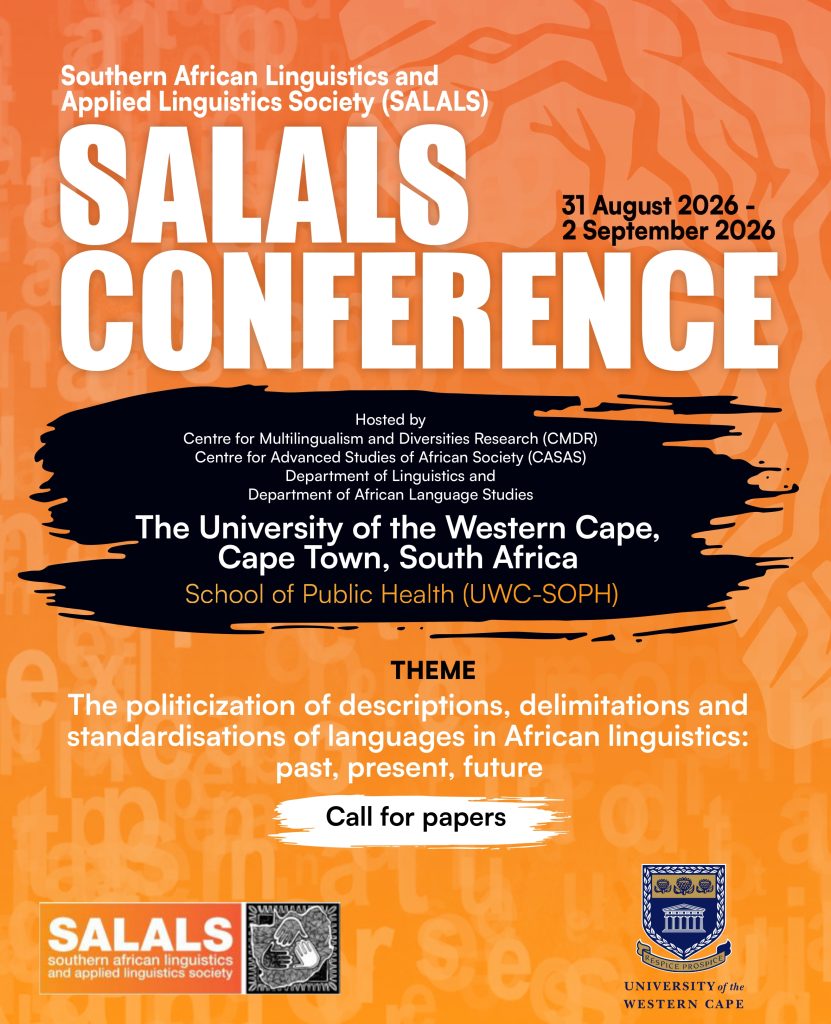
Language is inherently political, but so has been our discipline of linguistics in Africa. Since its
naming, linguistics has produced the assumptions, questions, frameworks, methodologies, and
conclusions that have led to a sustained politicization of descriptions (of structures, systems, practices,
praxis), delimitations (categorization, bordering, hierarchisation), and standardisations (codifications of
inclusion and exclusion) of languages since colonialism and into our post-Covid, GenAI, decolonial
twenty-first century world.
The 2026 Southern African Linguistics and Applied Linguistics Society (SALALS) conference theme
seeks to pull closer the diachronic (past), synchronic (present), and reflective and interrogative (future)
vocabularies of our field. We thus invite contributions that will link to the overall theme of the
conference by demonstrating how descriptions, delimitations and standardisations of languages have
been and continue to be (re)conceptualised, (re)imagined, (re-/co-/de-)constructed and (re-/dis-)
invented in African linguistics today.
Abstracts
Abstracts for papers, posters, and proposals for workshops are therefore invited in the following areas and any other areas of Linguistics, Applied Linguistics and Language Practice.
- Social justice and humanising pedagogy (linguistic diversity and inclusion)
- Digital humanities (language and technology and 4IR)
- Language standardisation
- Translation and interpreting
- Multilingualism in context
- First and second language acquisition
- Syntax
- Morphology
- Semantics
- Discourse analysis
- Phonetics and Phonology
- Language and the law (forensic linguistics)
- Gender, language, and power
- Semiotics
- Onomastics
- Language and Media
- Language, identity, and culture
- Language and medicine
- Language, knowledge, and archive
- Language and education
- Language and business
- Historical linguistics
- Linguistic migration
- Psycholinguistics
Workshop abstracts should include the following:
- Easy to read title
- A clear description of the aim of the workshop
- Workshop proposals may not exceed 500 words
Submission guidelines
Abstracts must be between 200 and 250 words long (not including references).
Abstracts can be submitted at the following link: https://easyabs.linguistlist.org/submit/SALALS2026/
Deadline for abstracts: 15 May 2026
Conference Fees
ZAR 3 990 – Non-members
ZAR 3 025 – Paid-up members
ZAR 1 650 – Students (non-members)
ZAR 1 350 – Students (paid-up members)
*Please visit the SALALS website (https://salals.org.za/membership/) for more information on how to apply for SALALS membership.
Registration
To register for the conference, please complete the registration form at the following link: https://www.formdesk.com/millennium/SALALS-registration
Plenary speakers
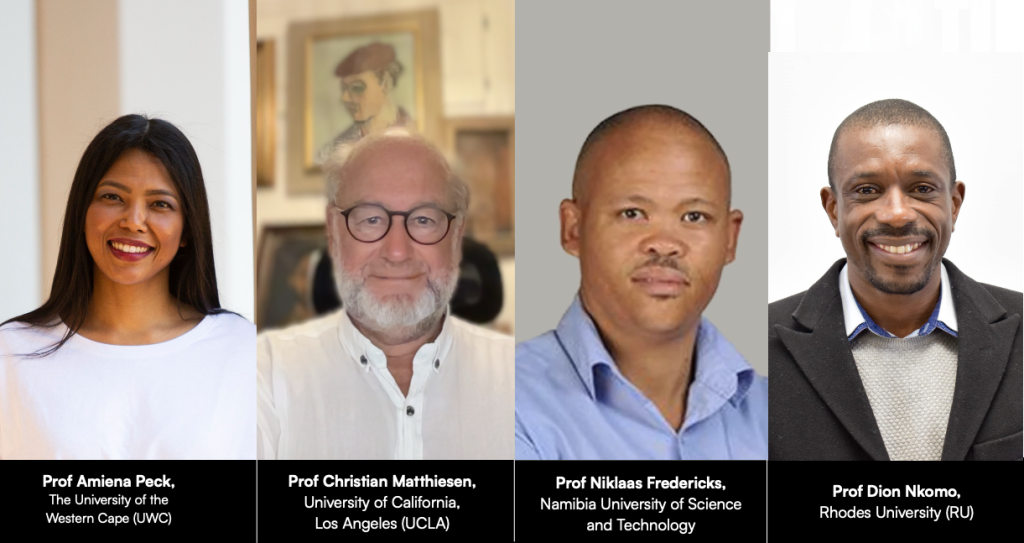
Amiena Peck
Amiena Peck is the Chairperson of the Linguistics Department at the University of the Western Cape and Chair of Humanities and Social Sciences Research Ethics Committee (HSSREC). She is a NRF-rated researcher specializing in linguistic landscape (LL) studies and has co-authored an edited collection of cutting-edge linguistic landscape research which explicitly foregrounds the importance of the human in research. Her volume entitled “Making sense of people and place in linguistic landscapes” (Bloomsbury Press, 2018), in tandem with a special issue in Sociolinguistic Studies entitled “Visceral landscapes” (2019), has gone a long way in sensitizing the field to the importance of embodiment, affect, bodies and space. Her interest in discourse, semiotics and identity management are also present in her contribution to teaching and learning, supervision and more recent publications on the importance of decolonizing the academic Self for more grounded sociocultural research (Peck, 2021). Bringing together new voices to the field, Amiena Peck consistently advocates for the use of autoethnography as a decolonial learning and teaching tool (cf. Tufi and Peck, 2025).
Christian Matthiesen
Christian M.I.M. Matthiessen has a degree in linguistics from Lund University (BA), where he also studied English, Arabic and philosophy, and a degree in linguistics from UCLA (MA, PhD). He has previously held positions at USC/ Information Sciences Institute, Sydney University, Macquarie University, the Hong Kong Polytechnic University, Complutense University, Hunan University, and the University of International Business and Economics. He is Honorary Dean of The Language Studies Institute of Sun Yat-sen University, Honorary Professor of Beijing Normal University, and Honorary President of the International Association for Hallidayan Linguistics. Together with Associate Professor Jorge Arús-Hita, he has launched a new online Masters course in Systemic Functional Linguistics at Complutense University, Madrid, Spain, for students around the world. Matthiessen’s research, publications, and teachings include a range of theoretical and applied areas: multilingual studies — including description of particular languages, translation studies, comparative and typological studies; health communication studies, educational linguistics, language description, applicable discourse analysis (including the use of Rhetorical Structure Theory), registerial cartography, language arts, the language of space, and the development of Systemic Functional Linguistic theory. Together with M.A.K. Halliday, he has worked on the description of English lexicogrammar and semantics, and Systemic Functional theory. Matthiessen has authored and co-authored over 15 books and 180 book chapters and journal articles. The most recent books are Matthiessen (2021), Systemic Functional Linguistics, Part I, edited by K. Teruya, which is the first of eight volumes of his collected works, and Volume 2 will be published in 2025; Matthiessen, Wang, Ma & Mwinlaaru (2022), Systemic Functional Insights on Language and Linguistics. Matthiessen & Teruya (2024), Systemic Functional Linguistics: a complete guide (Routledge), Matthiessen (2023), System in Systemic Functional Linguistics: a system-based theory of language and Matthiessen (2025), Systemic Functional Linguistics: Part II. Wang & Ma (2023), Theorizing and Applying Systemic Functional Linguistics Developments by Christian M.I.M. Matthiessen, provides an overview of some domains of his work. He is currently preparing several books, including the fifth edition of Halliday’s Introduction to Functional Grammar (Routledge). A selection of his talks and lectures are available on his YouTube channel.
Niklaas J. Fredericks
Prof Niklaas J. Fredericks is an associate professor and head of department (Communication and Languages) in the Faculty of Commerce, Human Sciences and Education at the Namibia University of Science and Technology. He holds a PhD in linguistics from the University of the Western Cape. His research interests include sociolinguistics and Khoisan linguistics, particularly phonetics and phonology. His contribution in the field of Khoesan languages stretches over 16 years to date when he was involved in orthography development for several Khoe and San languages. To date he was instrumental in the development of “the Standard Unified Orthography for Khoe and San languages of Southern Africa”, Ortografia Padrã Unicada Da Lingua !Xun’, and “The Unified Standard Orthography for Tjoao Language”. In addition, he was also involved in documenting the endangered Kora language spoken by the original inhabitants of the early Cape and Gariep. He recently concluded two projects, the “Nama genocide survivor narratives”, and “language acquisition” research, also in Southern Namibia. His teaching vision and philosophy is modelled on a student-centred approach where quality learning is promoted through critical analysis of research. This he does by enhancing a healthy student and teacher rapport where students are free to express themselves on close supervision by the teacher. He lectures at both undergraduate and postgraduate levels and supervises several theses in various areas. He has published several articles in peer-reviewed journals, one of which is an award-winning paper entitled “Voicing in non-click consonants and orthographic design in Khoekhoegowab”, published by the South African Journal of African Languages in 2018.
Dion Nkomo
Dion Nkomo is a professor of African Language Studies at the School of Languages and Literatures at Rhodes University, and an extraordinary professor in the Department of African Languages at Stellenbosch University. He obtained his PhD in lexicography from Stellenbosch University, has worked at the Universities of Zimbabwe and Cape Town, and now holds a SARChI Chair on Intellectualisation of African Languages, Multilingualism and Education at Rhodes University. His academic interests include language planning and policy, language teaching, lexicography, multilingualism, sociolinguistics, translation, terminology, and higher education studies. He is currently the president of the African Association for Lexicography (AFRILEX) and associate editor of Lexikos.
Contact Information
For any queries related to the conference, please email salalsconference2026@uwc.ac.za.